
Japan is facing a rapid population decline, with rural communities among the hardest hit. Nearly 9,000 schools closed between 2002 and 2020, and around 450 continue to shut down each year. As birth rates fall and towns shrink, schools—once central to daily life—stand empty, their presence quietly fading from the landscape.
Kūseki, meaning “empty seats,” responds to this ongoing disappearance. Through photography and collage, I document closed school buildings in Niigata Prefecture, where I grew up—one of the regions most deeply affected by depopulation. Reimagined as fragmented visual forms, the collages are composed from multiple photographs that are precisely cut, rearranged, and reassembled into disjointed configurations. The disrupted architecture evokes a sense of instability and fragmentation, mirroring the slow disintegration of these institutions and the communities they once anchored.
While rooted in a specific national context, the work speaks to broader concerns around memory, impermanence, and the social impact of depopulation. The shuttered buildings—fenced off, weather-stained, and quietly collapsing—embody the gradual disappearance of once-vital institutions.
The project reflects on what remains visible and what has already slipped from view, prompting reflection on what such absences mean—for education, for community, and for the future of rural life.
Kūseki is not only about decline. It is about bearing witness—giving form to what lingers in absence, and inviting viewers to consider the weight of what has been quietly lost.
Created for Jerwood/Photoworks Awards 5
This sound work brings together children’s voices and environmental recordings from a primary school in Niigata, extending Kūseki into an auditory space.
Niigata Prefectural Kōnōkan High School (1964–2002)
Closed in 2002
37 students
Peak in 1965
526 students
Joetsu City Katakai Primary School (1877 – 2004)
Closed in 2004
35 students
Peak in 1965
Data on peak enrollment is unavailable
Joetsu City Nakahokura Primary School (1877–2017)
Closed in 2017
25 students
Peak in 1995
83 students

By Almantas Petkunas
Teradomari Town Yamanowaki Primary School (1909–2003)
Closed in 2003
35 students
Peak in 1972
98 students
Nagaoka City Nishidani Primary School (1872–2015)
Closed in 2015
8 students
Peak in 1972
103 students
Joetsu City Kushiike Primary School (1874–2004)
Closed in 2004
39 students
Peak in 1959
403 students
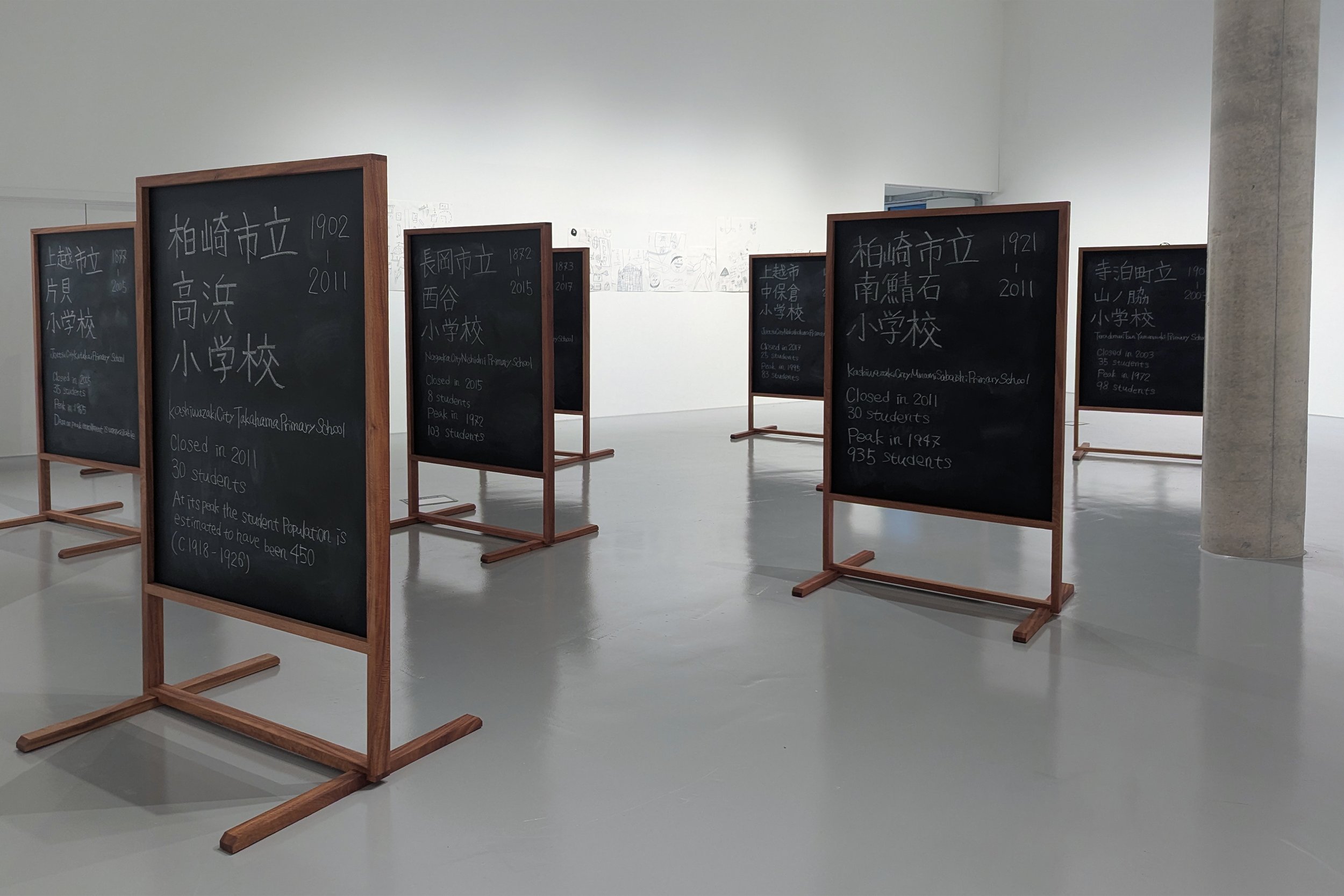
Kashiwazaki City Minami-Sabaishi Primary School (1921–2011)
Closed in 2011
30 students
Peak in 1947
935 students
Nagaoka City Shimo-Oguni Primary School (1873–2017)
Closed in 2017
46 students
Peak in 1971
274 students
Kashiwazaki City Takayanagi Junior High School (1947–2019)
Closed in 2019
16 students
Peak in 1939
756 students
Kashiwazaki City Takahama Primary School (1902–2011)
Closed in 2011
30 students
At its peak, the student population is estimated to have been around 450 (c. 1918–1926)